Training Lab · Reinforcement learning
Your robot learns by practice.
Here is what happens in every step.
Nobody programs the gait. The robot tries, the task scores every attempt, and an algorithm called PPO slowly shifts the robot’s behaviour toward what scored well. This page explains that loop, the choices kualia makes for you, and how to read what comes out of a run.
PPO
algorithm in every Studio run
2,048
steps collected per update
50
episodes behind each chart point
5
deterministic evaluation episodes
1The basics
Observe, act, get a reward, repeat
Reinforcement learning has two parties. The agent is a neural network, the policy, that decides what the motors do. The environment is everything else: the MuJoCo robot, the world around it and the task’s rules. They take turns, many times per simulated second.
| Word | In the Studio |
|---|---|
| Observation | What the policy sees: joint angles and velocities, and the position of world objects relative to the robot. |
| Action | One continuous number per actuator. Walker2d has 6, Humanoid 17. |
| Reward | A number the task code computes every step: progress, staying upright, small costs for effort. |
| Episode | One attempt, from the start pose until the robot fails (terminated) or time runs out (truncated). |
| Return | The sum of an episode’s rewards. Training tries to make it as large as possible. |
A policy that starts random mostly flails. Some attempts score a little better than others, and PPO makes the actions behind those attempts a bit more likely. After thousands of episodes the flailing turns into a gait, a kick or a balance.
Why the future counts less
PPO optimises a discounted return: a reward k steps ahead is weighted by γk, with γ = 0.99. The weight halves roughly every 70 steps, so the policy plans about a hundred control steps ahead. How long that is in seconds depends on the robot’s control rate: about 0.8 s for Walker2d at 125 Hz, 1.5 s for Humanoid at 67 Hz, 5 s for Ant at 20 Hz.
That is why dense, per-step rewards help so much: a reward that only arrives at the end of a long episode is almost invisible to the first few hundred steps of it.
2Exploration vs exploitation
To find better moves, the robot has to try worse ones
If the policy always did what it currently thinks is best, it would never discover anything better. So during training every action is sampled from a bell curve around the policy’s best guess.
- Exploration is the noise: actions near the best guess, sometimes far from it. It is how a random policy stumbles on a first step forward.
- Exploitation is the mean: doing what worked. As training goes on, PPO usually shrinks σ as it grows confident, and the behaviour becomes more consistent.
- The training chart shows exploring episodes. Checkpoint replays, the evaluation episodes, the live policy and the ONNX export are deterministic: the same observation always gives the same action.
- This is why a checkpoint often looks better than the chart suggests, and why a policy can look shaky during training but steady in evaluation.
No bonus for randomness
The Studio keeps PPO’s entropy bonus at zero: nothing rewards acting randomly for its own sake. Exploration comes only from the learned spread σ, which PPO narrows as the policy improves.3The algorithm
Why the Studio trains with PPO
Proximal Policy Optimization is the workhorse of robot learning in simulation. The Studio runs it through Stable-Baselines3 with the library’s default settings, on a single environment per run. Three ideas make it work.
1 · Actor and critic
Two small networks read the same observation. The actor is the policy. The critic predicts how much return to expect from here, so each action can be judged against expectations instead of in absolute terms.
2 · Advantages with GAE
The advantage says how much better an action turned out than the critic expected. Generalised Advantage Estimation blends short and long look-aheads (λ = 0.95) into one steady signal.
3 · A clipped update
PPO compares how likely each action is under the new policy versus the old one (the ratio r). Beyond 1 ± 0.2 there is nothing more to gain, so one lucky batch cannot drag the policy off a cliff.
obs
normalised
Actor · the policy
Critic · value function
1Collect
2,048 steps with the current policy (n_steps)
2Score
advantages with GAE · γ 0.99 · λ 0.95
3Update
10 epochs × 32 minibatches of 64 = 320 gradient steps
4Discard
on-policy: the batch is thrown away, repeat
| Setting | Value | What it does |
|---|---|---|
| n_steps | 2,048 | steps collected with the current policy before each update |
| batch_size | 64 | minibatch size for each gradient step |
| n_epochs | 10 | passes over each collected batch |
| learning_rate | 3 × 10⁻⁴ | Adam step size, constant |
| gamma (γ) | 0.99 | discount: how much future reward counts |
| gae_lambda (λ) | 0.95 | bias/variance trade-off of the advantage estimate |
| clip_range (ε) | 0.2 | how far one update may move the policy |
| ent_coef | 0.0 | no extra entropy bonus; exploration comes from the learned σ |
| vf_coef | 0.5 | weight of the value-function loss |
| max_grad_norm | 0.5 | gradient clipping for stable updates |
| policy | MlpPolicy | separate 64-64 tanh networks for actor and critic |
One algorithm, on purpose
Every Studio run uses PPO with these values, and continuing a run keeps them. When version 4 beats version 3, the difference comes from the task, not from a tweaked optimiser.Other algorithms
The training service underneath is built on Stable-Baselines3 and can also run A2C, SAC, TD3 and DQN, and the ONNX exporter understands their policies. The Studio does not offer them: every Studio run is PPO.4Scaling
Normalised observations and rewards
A torso height of 1.25 m and a joint spinning at 8 rad/s are different kinds of number. Neural networks learn much faster when every input has a similar scale, so training wraps the task in Stable-Baselines3’s VecNormalize.
raw values · very different scales
normalised · comparable, clipped ±10
- Observations: running mean and standard deviation per value, updated during training, clipped to ±10.
- Rewards: scaled by a running estimate of the discounted return’s spread (γ = 0.99), clipped to ±10. This keeps the critic’s targets in a sane range whatever the units of your reward.
- The chart stays honest: a Monitor wrapper sits inside the normalisation and records the raw episode return and length, in the task’s own units.
- Evaluation freezes the statistics and reports raw rewards. The same frozen observation statistics are baked into the exported ONNX file, so on the robot you feed raw sensor values.
5Designing the experience
How alia turns a sentence into a task
The robot can only learn what the task pays for. alia writes that task from your brief: a world planner first decides which objects the trick needs, then alia works out the goal, a metric you could measure and the constraints, restates the trick in one sentence with a 3–5 step picture of a successful episode (shown on the Plan page as “What success looks like”), and implements it all as reward terms, success and termination rules, observations and curriculum knobs.
Goal
ball moves into the goal
Metric
ball within 0.3 m of the goal mouth
Constraint
no falling, no flailing
Reward terms
progress toward the goal, staying upright, small effort cost
Success
a measurable end state, read when the episode ends
Termination
failure: fell over, flipped, left the area
Truncation
time limit: max_steps control steps
Observations
joint angles and speeds, object positions
Curriculum
knobs for easier or harder starts
Reward shaping
A reward is normally a weighted sum of terms. Dense shaping, the default, pays for progress every step: distance closed to the ball, speed toward the goal, height gained. The robot gets a useful signal from its very first attempts. Goal-based rewards pay a clear bonus for finishing plus light shaping: cleaner behaviour, slower learning, because the bonus is rare early on.
- forward velocity× 1.0
- upright× 0.5
- control cost− 0.001 Σa²
- fall penalty− 10, once
Per-step rewards should stay roughly within ±10; alia’s rules clip them there and the Reward is sane check warns when random actions produce values outside that range.
Pitfalls alia and the review look for
| What you see | Why it happens | The fix |
|---|---|---|
| The robot stands still and the reward looks fine | A survival bonus outweighs the progress terms: standing still collects it risk-free. | Lower the bonus or make it depend on progress; raise the progress weight. |
| The robot falls on purpose | Every step is net negative, so ending the episode early is the best strategy. | Make a normal upright step slightly positive; keep penalties smaller. |
| The ball flies sideways | Reward hacking: the task pays for ball speed in any direction. | Reward progress toward the goal instead of raw speed. |
| No progress in a short run | A goal-based reward on a hard trick: the bonus is never seen. | Switch to dense shaping or start with an easier stage. |
| Reward rises, success stays at 0 % | The reward and the success criterion disagree. | Align them, or loosen the criterion in the next version. |
Success
Reported in info["is_success"] and read at the end of an episode. In kualia’s MuJoCo runtime an episode only counts as a success if it reached the time limit without failing and is_success() holds, so tasks don’t end on success; the robot holds the result until time runs out.
Termination vs truncation
Terminated means failure, for example the robot fell below half its start height or flipped over. Truncated means time ran out after max_steps. Every threshold must already hold at the start pose, or every episode ends at step one.
Curriculum
The starting difficulty (Easy by default) sets episode length and how forgiving the thresholds are. Curriculum knobs, such as a target distance, are plain constructor arguments of the task, and the plan lists curriculum stages. Making it harder is a new version: “move the ball to 2 m”, “tighten success to 0.2 m”.
6Guard rails
Checks that make sure there is something to learn
Before a single paid training step, every task version runs 13 checks in an isolated sandbox. Three of them are about learning itself (reward sanity and the two below); training cannot start until all 13 pass.
action_effect
Learnability estimate
Over five seeds, a 50-step rollout with random actions must earn a different return than one with zero actions. If nothing the robot does changes the reward (a constant bonus, a term reading the wrong variable, a reward that is a function of time), no algorithm can learn from it.
episode_length
Episodes survive reset
Five random-action episodes (up to 300 steps) must last more than two steps on average. The classic broken task terminates at the start pose, for example a height test on a value that is zero at reset, and would burn the whole budget on one-step episodes.
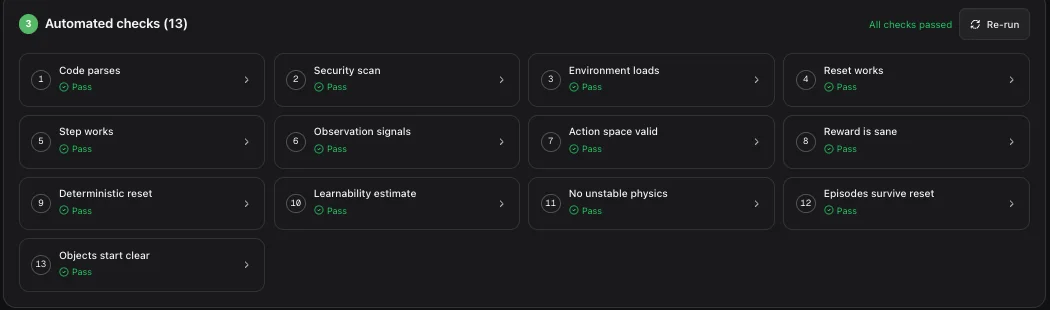
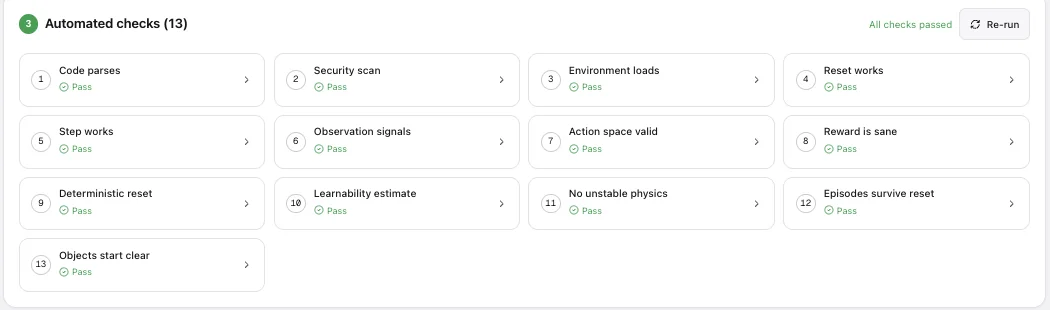
- Reward is saneFinite at every step
- Deterministic resetSame seed, same start
- No unstable physicsNo NaN, bounded state, episodes end
- Objects start clearWorld objects start away from the robot and each other
- …plus syntax, security scan, import, reset, step, observation and action space checks.
7Watching it learn
Reading the curve, then judging fairly
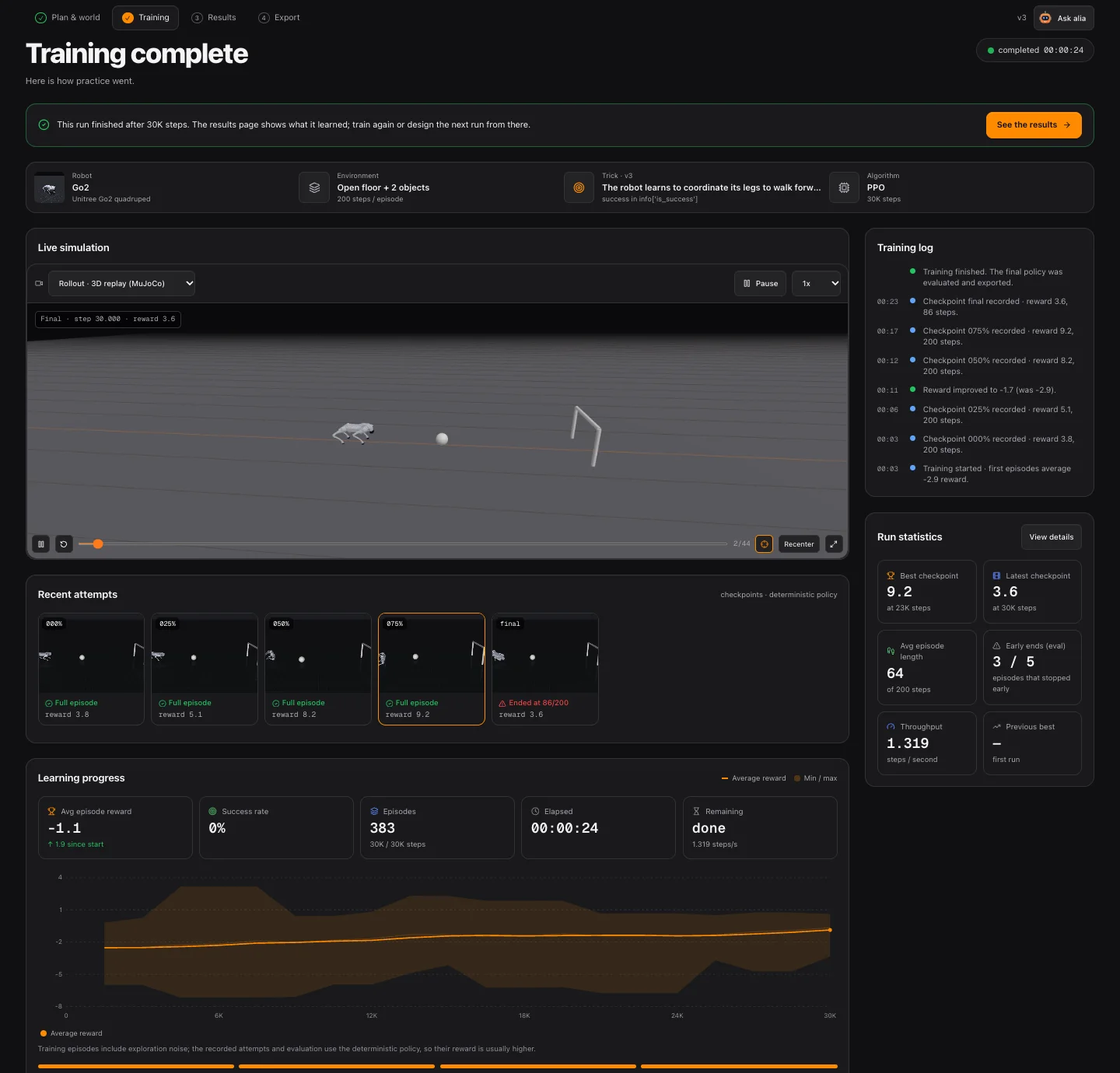
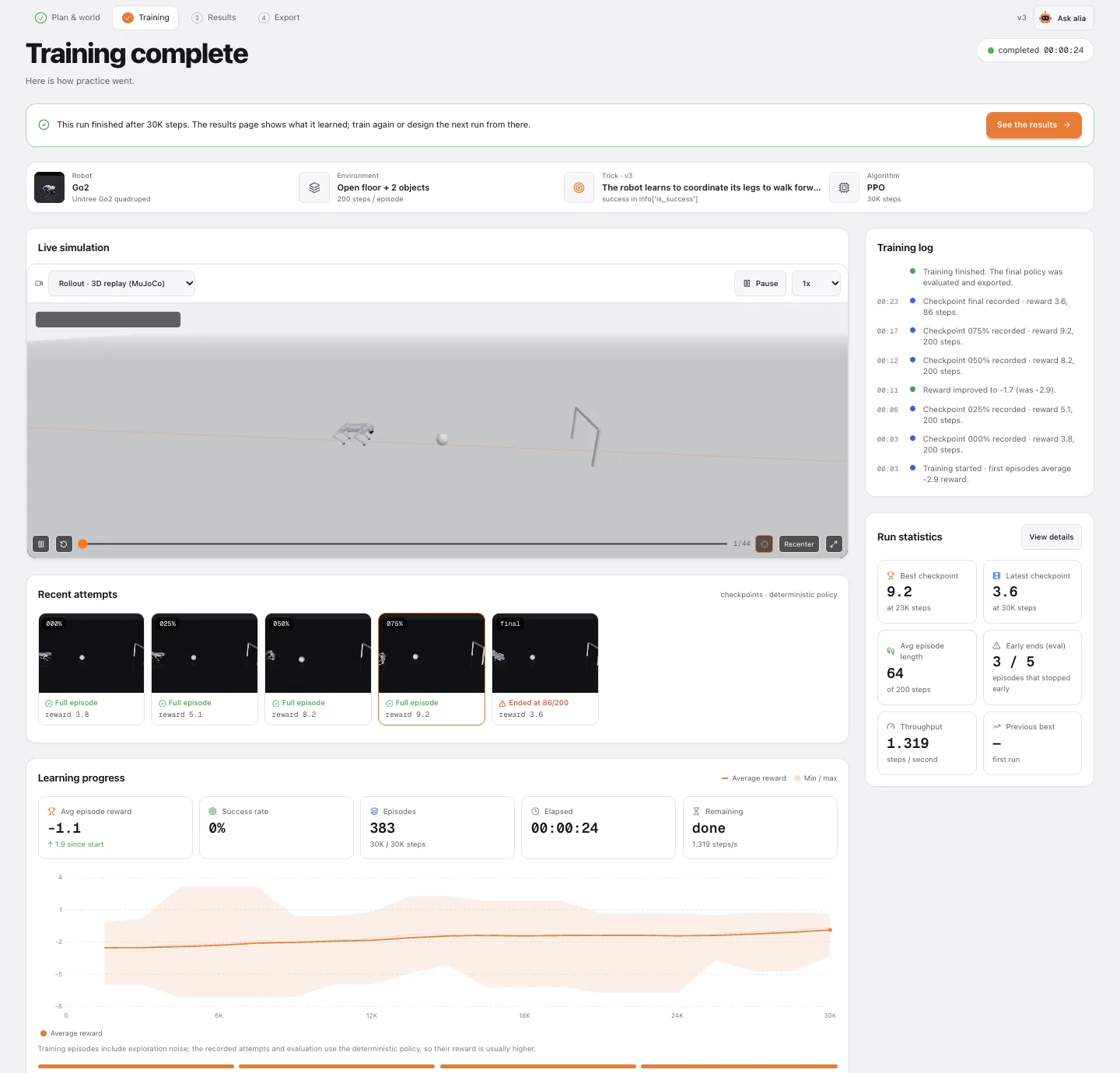
While training runs, the Studio adds a point to the learning chart about every 5 % of the budget. Each point summarises the last 50 finished training episodes.
| Metric | Read it as |
|---|---|
| Mean episode reward | Is the robot collecting more of what the task pays for? |
| Min / max band | How consistent the attempts are. A wide band early is normal. |
| Success rate | Share of the last 50 episodes that met the success criterion. |
| Episode length | Longer usually means fewer falls; very short means early termination. |
| Throughput | Steps per second, used to estimate the remaining time. |
Checkpoints
The untrained policy is recorded first, then at 25, 50 and 75 % of the budget, then the final policy. Each checkpoint plays one deterministic episode that is saved as a video and as a MuJoCo trajectory for the 3D replay. From the 25 % checkpoint on, the newest checkpoint policy can run live in your browser while training continues.
Deterministic evaluation
After training, the final policy plays 5 episodes with seeds 0–4, deterministic actions and frozen normalisation, and the raw rewards are recorded. An episode that lasts at least 95 % of max_steps counts as a full episode. These are the numbers on the run’s results page.
8Iterate
The AI review, versions, and how long it takes
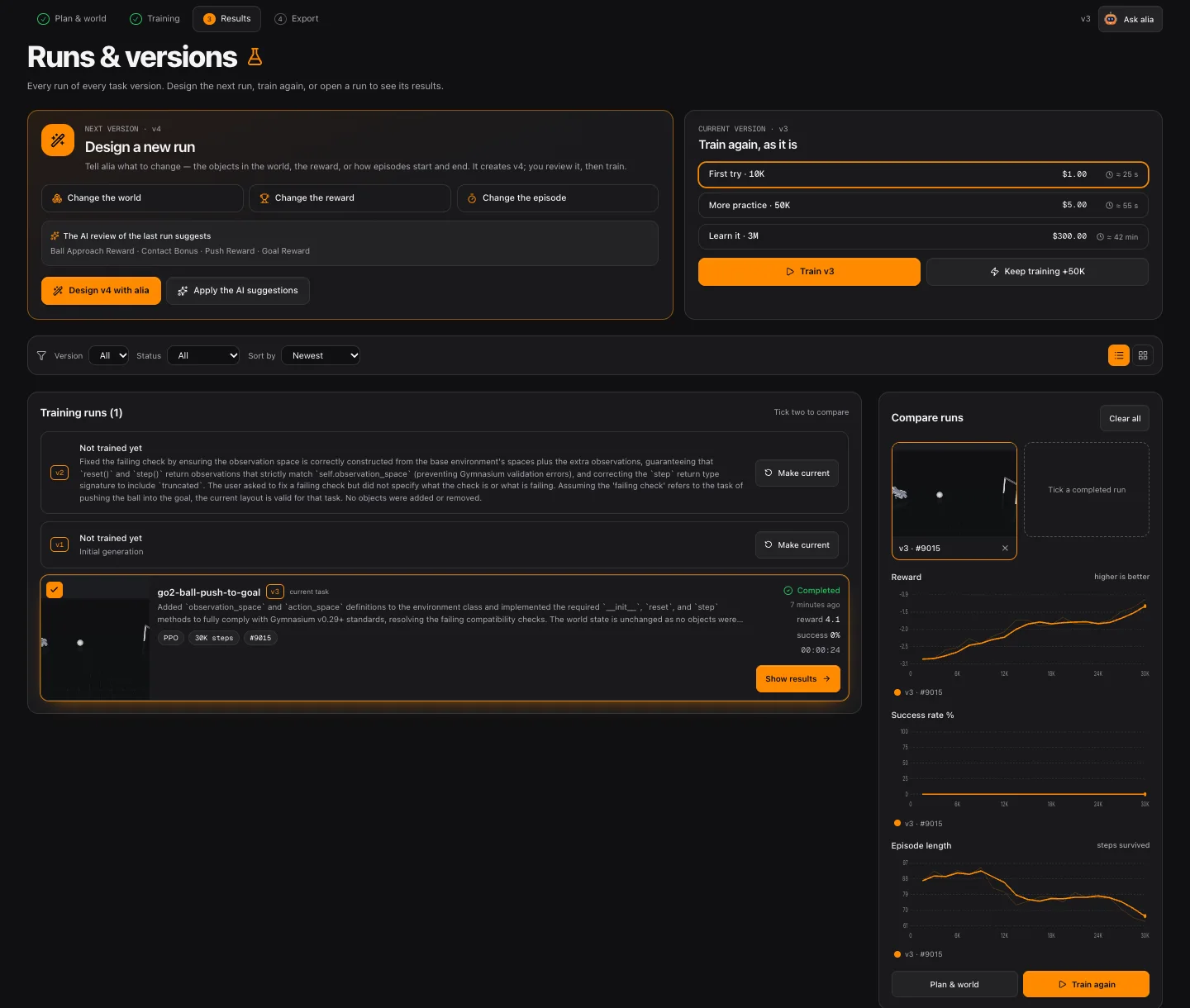
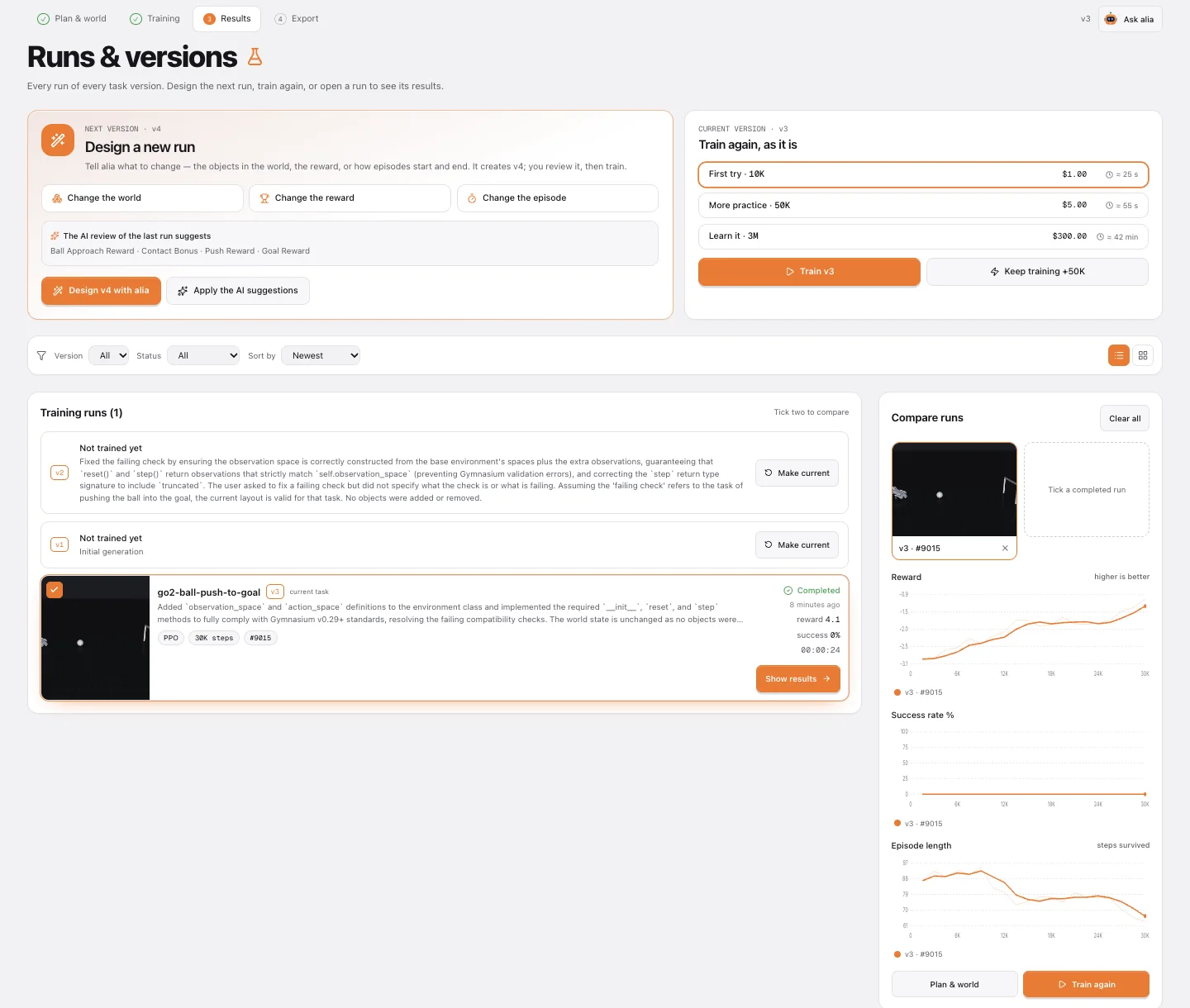
Reinforcement learning is a loop of experiments: run, look, change one thing, run again. kualia keeps every run of every task version so that loop stays honest.
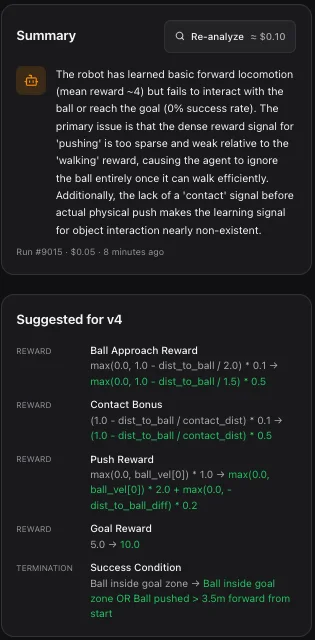
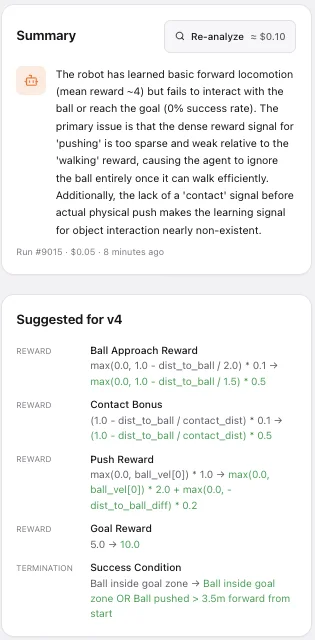
The first time you open a run’s results, an AI review reads the training curve, the evaluation numbers, the recorded episodes and the task code. It writes a short summary of what the robot does, 2–4 observations with a severity, and 3–6 proposed changes tagged reward, termination, observation, curriculum or hyperparameters, each with the current value, the proposed value and why. One click turns its instruction into the next version, which runs the 13 checks again.
How many steps a robot typically needs
The Studio’s “Learn it” budget per robot, with what it means for PPO: the number of 2,048-step iterations, and how much simulated time the robot practises at its control rate. These are rough guides for a real skill, not guarantees. The realistic Menagerie robots need far more practice than the classics.
| Robot | Learn it | PPO iterations | Control rate | Simulated practice |
|---|---|---|---|---|
| InvertedPendulum | 30K | ≈ 15 | 25 Hz | ≈ 20 min |
| Reacher | 100K | ≈ 49 | 50 Hz | ≈ 33 min |
| Hopper | 300K | ≈ 147 | 125 Hz | ≈ 40 min |
| Walker2d | 500K | ≈ 245 | 125 Hz | ≈ 1.1 h |
| HalfCheetah | 300K | ≈ 147 | 20 Hz | ≈ 4.2 h |
| Ant | 1M | ≈ 489 | 20 Hz | ≈ 13.9 h |
| Humanoid | 2M | ≈ 977 | 66.7 Hz | ≈ 8.3 h |
| Dynamixel2R | 50K | ≈ 25 | Hz | ≈ NaN h |
| LowCostArm | 200K | ≈ 98 | Hz | ≈ NaN h |
| SO101 | 300K | ≈ 147 | Hz | ≈ NaN h |
| Crazyflie | 300K | ≈ 147 | Hz | ≈ NaN h |
| Duck | 2M | ≈ 977 | Hz | ≈ NaN h |
| Toddlerbot | 5M | ≈ 2,442 | Hz | ≈ NaN h |
| OP3 | 5M | ≈ 2,442 | 50 Hz | ≈ 27.8 h |
| Panda | 500K | ≈ 245 | 50 Hz | ≈ 2.8 h |
| Go2 | 3M | ≈ 1,465 | 50 Hz | ≈ 16.7 h |
| Spot | 3M | ≈ 1,465 | 50 Hz | ≈ 16.7 h |
| G1 | 10M | ≈ 4,883 | 50 Hz | ≈ 55.6 h |
Uploaded robots default to 300K steps. A 10K-step first try is still worth it on a big robot: it shows whether episodes survive, whether the reward rises and whether the behaviour points the right way, before you pay for a long run.
Questions
Why PPO and not SAC or another algorithm?
Can I change the hyperparameters?
Why is the checkpoint reward higher than the chart?
Why is the success rate different on the chart and on the results page?
All 13 checks pass. Will the robot learn the trick?
How many steps does my robot need?
Put the loop to work.
Describe a trick, check the plan, and run a 10K-step first try.